
Michael Williamson remembers Denny Heck as a masterful artist, beloved teacher, and extraordinary friend whose artistic vision influenced generations at Germantown Friends School.
By Michael Williamson
I was invited to dinner as a new, unproven member of Germantown Friends School art faculty. The house was set far back from the road, a dogleg property behind a larger, patrician house. An expanse of open windows looked out on a once formal garden with a fountain in a pond, and a sweeping view of a distant estate across a valley.
On the left as you entered was a den with floor to ceiling bookcases. Snacks and wine were set out for immediate consumption and conversation. For dinner, Denny brought out a steaming platter of perfectly roasted chicken in a piquant sauce laced with capers. The platter and plates were colorful majolica from Deruta, Italy. The house, the setting, the furniture, the tableware, it all struck me: an extraordinarily beautiful environment.
This was the first of countless meals over thirty years of friendship. The house, the conversation, the food, the laughter, the mise en scène were distinctly choreographed by Denny; convivial and seemingly effortless. Denny filled the house with her collections of boxes, wooden balls, curious animal sculptures, blue Chinese porcelain bowls, an aquarium with goldfish, comfortably worn down-filled sofas and chairs, threadbare yet exquisite oriental carpets, shells, and of course pictures and books. Later, when she moved to a farm outside town, or to a ranch- style in the suburbs, or to a row house in Chestnut Hill, each home was a new expression of her amazing eye for creating engagingly beautiful environments.
In each house she nested with the beautiful objects that gave her pleasure and security. Pictures and books, objects of exquisite interest and beauty were Denny’s love language. Everything was touchable.
We traveled together often over the years—art class trips to DC and New York, and art faculty excursions to Pittsburgh, Washington, The Clark Institute, the Williams College Museum, and MASS MoCA. The GFS choir trip to China was a highlight. In Hangzhou we walked the gardens, overwhelmed by the huge koi, the variegated pathways, the plantings, and bridges. We visited a tea plantation shrouded in mist with mountains that rose shockingly straight up from the earth. Students asked us to take them to a market in Shanghai. It was crowded, cheek by jowl. We were pushed and prodded to enter stalls and buy. We sorted through a pile of tacky prints to find handmade papier collé painted images that we purchased. A sophisticated lady from the 1920s appeared in a variety of scenes; with bobbed hair leaning languidly against a chair, absently looking out a window, or sitting with her hands inwardly facing, a full bouquet of flowers in her ornately decorated room.
My memories are vivid in large part because Denny’s vital sensitivity to people, sights, scenes heightened the experience. Her enthusiasm for and enjoyment of all things beautiful gave students and faculty alike a deeper engagement with our hosts and the local choruses we sang with. Language was no obstacle. Her manner and positive spirit created an emotional bond with others.
Did I mention humor? We often laughed until our stomachs ached. At her core Denny remained a child. Abundantly curious, eyes wide open. Playing with her food. Heart open always to children and to animals. At a student production of The Potting Shed, a recorded sound was miscued. Instead of a knock on the door, a dog barked. The actor’s line was delivered anyway, “It must be your mother.” We tried to squelch our laughter but just couldn’t.
As a teacher Denny created a classroom where the chaos of the outside world fell away. She broke down drawing and painting to digestible bites for her students and made complicated things less formidable. ‘Art is art, and everything else is everything else’ was her mantra.
Her gift to her students, and I dare say to the entire Germantown Friends community, was to bring ideals of beauty and intelligence to the fore. She elevated art to an astral plane, a realm of being that was aspirational and spiritual, yet obtainable. She was an exemplar of philosopher John Dewey’s dictum, ‘life and art are inseparable’. She was able to draw out the best in students, who at times were shocked themselves by how they could realize an idea and make it visually interesting. She inspired generations of Germantown Friends students to seek their bliss creatively, intelligently, rigorously, passionately, generously, and kindly—’in the manner of Friends’.
Her art practice informed her teaching. Her teaching informed her art practice. At one time, traditional Quakers eschewed art, music, and decoration as frivolous vanities. Denny reframed
such “worldly pursuits” as divinely inspired. She delivered in the classroom. She lived her values. Quakers say, ‘Let your life speak’.
My three children were shaped by Denny as friend and teacher. When Avery was born, Denny called and said dinner was on its way. She arrived at our house with Chinese food and stayed to enjoy it with us. She held each of my children close. In the classroom and in life she inspired them to be uninhibitedly creative. If I were detained in a meeting, she graciously set up painting projects for them. She hugged and tickled. Denny was a nurturer. She was drawn to children, like herself, who were vulnerable, sensitive, thoughtful, and introspective. I am forever grateful for her presence in my children’s lives.
So Denny the person was intelligent, kind, and humorous. What about Alden Mellor Heck, the artist?
At age fifteen Denny spent a year in Paris. She attended the Académie Julien and, with older students who ‘adopted’ her, visited the Louvre, Jeu de Paume, Musée d’Orsay, and galleries. She was impressed by the boldness of Cézanne, Picasso, and Matisse, but found deeper kinship with the Barbizon school; Jean-Baptiste-Camille Corot, Charles-Francois Daubigny, and JeanFrancois Millet. What attracted her to the more traditional painters was, I think, that their goal was not to make people to see things in a new way, like the impressionists, but to make people to see things as they really are. She focused on impeccable technique, painterly brushstroke, attention to surface detail, a wide range of color values, chiaroscuro modeling, and nuanced light. Craft, light, and color were important, not style.
From Corot, Denny absorbed bucolic, agrarian landscapes. She drew from his luminous dusky skies, restrained palette, and nuanced analogous color relationships. In Ville d’Avray, Corot creates a physical tension between the foreground, middle ground, and background by blurring the horizontal edge between the trees and the sky while adding dashes of surface paint, daubs in the foreground, like water droplets on the picture surface. This is a painting device Denny used repeatedly
Daubigny’s art embodies a quiet stillness that is such a vital part of Denny’s emotional timbre. Hers are curated worlds. Familiar fleeting experiences of color and deep feeling, capturing a moment in time and light. While the technique and attention to craft honor historic eras of the history of art, the images evoke a modernist’s psychological drama. The scenes are spare. Each compositional element aligns intentionally. Expectations of symmetry in a lone tree in a field, surprisingly off balance.
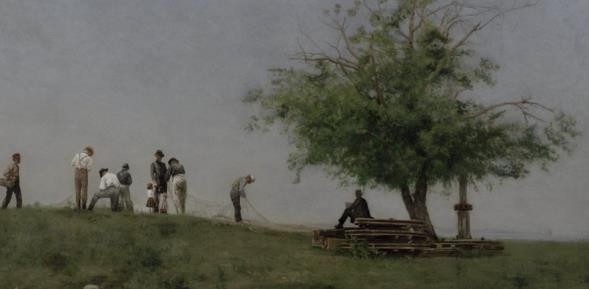
As a life-long Philadelphian she was familiar with Thomas Eakins and the great American illustrator N.C. Wyeth. Wyeth’s spectacular painting The Giant,
1923, resides in the dining room of the Quaker Westtown School, a campus we often visited. Violet Oakley, the preeminent muralist who studied at the Pennsylvania Academy of Fine Arts, created the epic murals at the Pennsylvania Statehouse. Oakley attended the Christian Science Church adjacent to Germantown Friends School, and lived at ‘Cogslea’ on St. Georges Road in West Mount Airy. She designed the Germantown Friends School seal in 1924 with these words inscribed, “Behold I Set Before Thee an Open Door.”
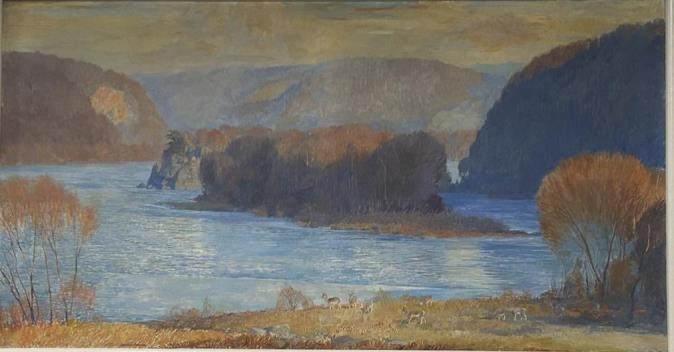
The Bucks County impressionists Edward Redfield and Daniel Garber appealed to her for their luminosity, mastery of complementary contrasts and, great subtlety and variation in a northeast landscape dominated by green. Denny loved the extraordinary Garber at Penn Charter School. Inspiration was everywhere.
Denny’s painting palette was rich and eclectic: Yellow Ochre, Naples Yellow, Cadmium Yellow, Burnt Sienna, Ivory Black, Sap Green, French Ultramarine, Cerulean Blue, CobaltTurquoise Greenish, Cobalt Violet, Indian Red, Vermillion, Mars Violet, Scarlet Lake, Alizarin Crimson, Yellow Orange Lake, German Earth, Graphite Grey, Mars Black, Titanium White, Eakins, Mending the Net (1881) Philadelphia Museum of Art Daniel Garber, Island, (Wm. Penn Charter School) Zinc White. Netherlandish and Nordic artists were a draw for her for their dark, visceral imagery.
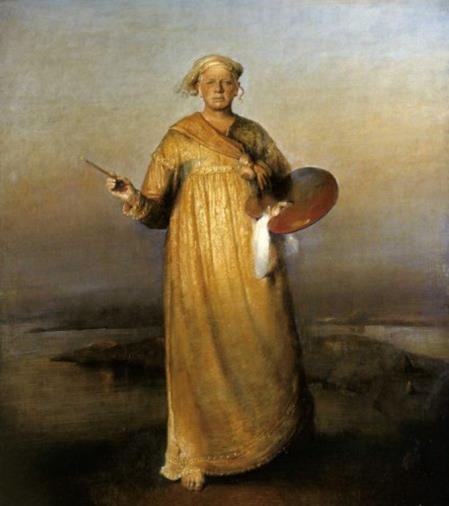
She loved Vermeer, Pieter Breughel, Edvard Munch, Odd Nerdrum, Vilhelm Hammershoi, among others. She admired Mondrian and de Hooch for their order, balance, and symmetry. Her work is suffused with nuanced color, light, spatial relationships, and the ephemeral. She was infinitely connected in her art with nature, the seasons, raking light, the off kilter, gesture, movement, and the abstract. Abstract defined as distilled from nature. Not arbitrary. Not careless.
Not gratuitous. Rigorous. Insightful. Always empathetic.
Denny was extremely well read. She was an innovative storyteller. Look at her paintings. Each tells a unique tale, a miniature haiku—a berg unmoored, leaves tossed in the wind, a field at dusk, a faraway land alive in the imagination, a gentle rainstorm, three bowls and a postcard of a Piero della Francesca portrait, a vase of irises on a reflective tabletop, a cottage swamped at sea. The brevity of haiku forces the artist to puzzle through word selection, syntax, punctuation, scale variety, and narrative. Early practitioners of Haiku sought to express a spiritual homage to nature by means of carefully curated sounds (unfortunately unavailable in translation) and images that suggest but do not define a moment in time.
A Poppy Blooms Katsushika Hokusai
I write, erase, write
erase again, and then
A poppy blooms
The Japanese concept of wabi-sabi; finding beauty in imperfection, was especially important to Denny in her painting, in her design sense, and in her interpersonal relationships. I believe this made her an infinitely patient teacher. In Denny’s work, structure is always evident: the rule of Odd Nerdrum, “Self-Portrait of the Prophet of Painting”, 1997,The Nerdrum Institute
thirds (as Denny correctly points out, it’s actually the rule of 1.618), the Golden Ratio, Josef Albers color theory, Anders Zorn’s four-color palette, Myron Barnstone’s lessons on composition, Bob Kulicke’s reverence for paint surface, Martha Erlebach’s exacting precision. Denny was a life-long learner. Her surfaces are well-considered and painstakingly developed. There are layers upon layers of color, there is spontaneity in paint application, there is accident and nuance. These paintings are world wise. They are saturated in experience and memory.
“Old paint on canvas, as it ages, sometimes becomes transparent. When that happens it is possible, in some pictures, to see the original lines: a tree will show through a woman’s dress, a child makes way for a dog, a large boat is no longer on an open sea. That is called pentimento because the painter ‘repented’, changed his mind. Perhaps it would be as well to say that the conception, replaces by a later choice, is a way of seeing and then seeing again.”
Lillian Hellman, Pentimento
In two decades as a colleague and friend, Denny permeated my life. I see her everywhere: inher koi painting and the prints of Chinese ceramics in my living room, in the little paintings we bought together in China, in the wooden carved cricket on the shelf in my hallway, in her abstract painting in my bathroom, in the painting Avery made in class, in the little watercolor of a cup, in the mounted butterflies we bought together, in the painted bouquet of flowers she gave us as a wedding present, in the careers each of my children have pursued.
Denny, I see you everywhere.
MICHAEL WILLIAMSON
