
A Polish author explores how during Ukraine’s crisis, Benjamin Franklin’s practical wisdom offers an antidote to romantic Polish national tendencies
By Romuald Roman
It’s easy to write about yourself, but if you stray too far from familiar vicissitudes of your own life, then recreating a realistic human character is more difficult to achieve. In my youth a daredevil, and to this day a joker, I have difficulty identifying with an ideal statesman like George Washington, or serious-to-the-point-of-pain John Adams, or morally conflicted slave owner Thomas Jefferson. But Benjamin Franklin? His outsized personality, his humor, his communitarianism, his idealism, his pragmatism… Now there’s a man for all ages! In fact, I’d rather write about Franklin than write about myself!
If the German nation was created by philosophers, the English by merchants and the Italian by artists, then who created the Poles? Alas, the Polish character was created by poets, and even worse, Romantic poets. Poles are sad, sensitive, jittery, and complain about everything. We’’ve lost battles heroically, cried for our lost homeland, and put honor above wealth, all to no avail. If, instead of Juliusz Słowacki, Poles had read Franklin, their country would have been richer, happier, and more powerful. Consider Słowacki’s romanticization of death by armed horsemen in these eight memorable lines:
> Surging like a vast current of salmon or sheatfish,
> Coiling up and down like an iron serpent
> That rears now its torso, now its head,
> The armed horsemen breast the prairie grass. —
> But hold! my song’s device breaks down:
> My Muse begs a rest, having drained her cup
> Empty of sweet nectar; and so, farewell
> To you, on that steppeland rise…
Hard to drain your cup of sweet nectar and build a nation at the same time! We Poles are unlucky Franklin was born in Boston, not Warsaw. But never too late! It’s been a couple of centuries, and we have a long way to go, but who knows, perhaps, after some delay, Franklin medicine will heal the Polish soul.
One can hope, always. No matter, because writing this book was great fun. Thanks to having the complete works of Franklin in several volumes on my study shelves, I didn’t have to run around libraries or search the Internet. I read for myself page after page of what the Philadelphia doctor wrote. What enjoyment! I could choose the tastiest morsels from a big platter, because some of Franklin’s most interesting insights were buried in his political or scientific writings. When I found something like this, it was like landing a fat fish out of a pond, like finding a cep mushroom in the woods.
I never thought I would write a book about Franklin. The idea occurred to me one evening when I was lost in the pages of Poor Richard’s Almanack. “What jewels!” I thought to myself as I took delight in one aphorism after another. I am uncomplicated, simple-minded, and literaryunprofessional. For those who have read Ulysses and À la recherche du temps perdu cover-tocover, these Franklin verses must seem as simple as a child’s drawing of a deer, filled as they are with infantile rhymes and trite half-truths.
Did I mention I am simple-minded? I thought, “The Almanack is great, but English is not my native tongue. I could learn Franklin’s wisdom more quickly and more efficiently by reading the Polish edition.” Makes perfect sense, doesn’t it? But despite Franklin’s significance in American and European history, no Polish edition existed. Poles don’t need the Poor Richard’s Almanack—not with inspirational poets like Juliusz Słowacki!
So at night I read Franklin rhymes to my pillow, slowly absorbing the quaint English, always thinking, “How would you say this in Polish?” Then I thought, “Maybe my children and grandchildren—after all, they have some of my genes—could also, like me, enjoy Franklin. Maybe his advice would help them in life? Maybe they would remember me, their father or grandfather, as the one who encouraged them to follow this great American’s life wisdom?” So for each of my children, Peter, Matthew, and Katia, I bought Poor Richard’s Almanack. Will it help them? They know English. Will they wise up sooner? I hope so. In many life matters my children are already smarter than me.
To my daughter Katia, my oldest, I gave three copies: a modern easy-to-read version, a lovely special edition with illustrations by Norman Rockwell, and a collector’s edition more than a hundred years old, so I put a considerable amount into her education, but what a payoff! Katia is so enterprising Franklin himself would be proud of her. I’m proud of her too. She does good work for the community, feeding thousands of Ukrainian refugees in Warsaw. So I guess my Franklin strategy has been successful in at least one life.
But what about my fellow Poles who do not read English? Well, I think the time is now. The war in Ukraine created a miracle in Poland as throughout the world: awakening a global conscience. Normally when Russia attacks a weaker neighbor, other countries only look on, wringing their hands. No one dares meddle. If on the street you see a husband slap his wife in the face, you turn the other way and pretend you didn’t see anything, right? That’s the most convenient way. Keeps you from having to confront the husband, who clearly is already angry. And big, too.
Before our eyes, the Russian thug attacked Ukraine, and witnessing their heroic defense, the world said: “Leave Ukraine alone! This is not allowed! We will not let you carry out crimes!” Foremost among those who nobly defend Ukraine is Poland. Six million Ukrainians have crossed the border into Poland, and you know what? The government did not create any refugee camps. Poles invited refugees into their homes.
Prior to this crisis, how many decades did our two nations live in discord? And now such brotherhood! Where did this come from? I don’t know. Internet and television create a global village so the suffering of others is more immediate, closer to us, as if we ourselves are being wronged. Who knows if it may now be the rule, the natural reaction of the world, that nations defend justice around the globe.
So Poland’s heart is open today. Poles have embraced compassion and humanitarianism as a society. Let us nurture this new society with simple wisdom. Yes, this is a perfect time for Poles to understand the pragmatic idealism of Benjamin Franklin.
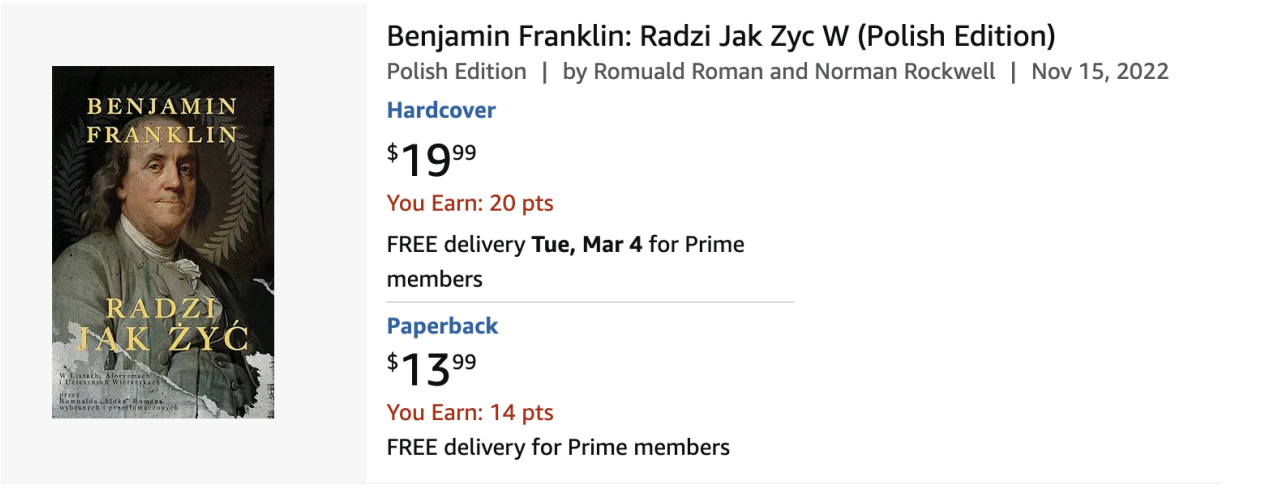
— Translation of the preface to
**Author Bio**
Romuald Roman is a popular Polish writer whose work has never before appeared in English. He is a graduate of the Agricultural University of Krakow and Temple University in Philadelphia. He has been a naturalist in Poland’s Tatra National Park, mountain climber, teacher, skier, expert on industrial toxicity at the EPA, and a UN consultant in Poland and Romania. He has published six books in Polish, two novels and four collections of stories, and is a member of London-based Związek Pisarzy Polskich na Obczyźnie (Association of Polish Writers Abroad). Since 1984, Roman has resided in Philadelphia. Married to his wife Jolanta for 45 years, they are parents of three grown children: Katia Roman-Trzaska, Matt Roman, and Peter Roman.
