
A monk practices “Unlimited Action” in life and art, challenging traditional moral restrictions with compassionate intent
By James Whipple Miller
His monastery, hidden down a back alley on a hillside, was far from the neon of downtown Seoul. Not a true monastery, really, more an ordinary house where the monk Jung-kwang and a few acolytes dwelled.
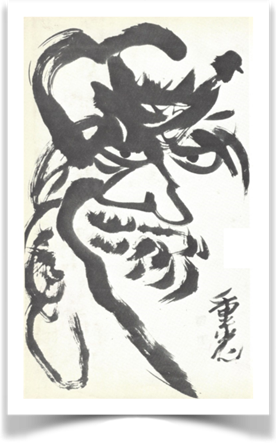
A shave-head in gray novitiate pajamas beamed a smile as he opened the door. He called into the interior, and soon the monk himself appeared to usher me in. I recognized him. I’d seen a set of photos of him in the act of painting. The sloppy, wide-open grin was unmistakable.
Another shave-head appeared, as did an aged nun, all in grey habit. The two novitiates were dispatched on an errand. The monk and the nun escorted me into a tatami room with a low table in the center and ink brush paintings on the walls.
Jung-kwang spoke no English, but had learned Chinese in his training. Buddhism came from China to Korea centuries before before Korea had a written language. It would be a thousand years before King Sejong the Great developed hangul, in the fifteenth century, to phonetically represent the native Korean language. For a thousand years, to be a Buddhist or to be “literate” in Korea meant to be literate in classical Chinese, and for a thousand years, Korean commentaries on the sutras were written in Chinese.
My Chinese was fluent from years of study, so we established a modicum of communication. “This is Auntie” the monk said, pointing to the nun. She spoke neither English nor Chinese, so the monk translated into Korean for her.
After a few minutes the novitiates returned and opened their packages on the table: a fifth of Johnny Walker black label and a platter of braised pork ribs. Then the novitiates ran to the kitchen and brought back stainless steel bowls of rice, and plates of steamed and stir-fried vegetables.
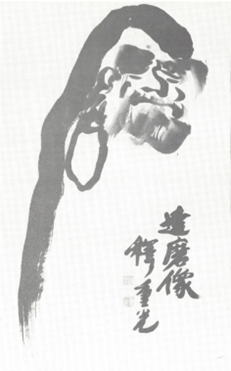
I thought Buddhists could not drink alcohol or eat meat.”. “They can’t,” he said pointing to the acolytes, “but I can.” He poured two generous portions of Johnny Walker, then reached for a pork rib. The pork ribs! Honey, garlic, ginger, soy sauce, sesame oil, chili paste, green onions, sesame seeds sprinkled on top. This meal occurred almost five decades ago, but to this day I remember the pleasant tremor I felt as the delicate and complex flavors cascaded across my palate.
“Wow!” I gasped, wiping my mouth with the wet washcloth beside my plate. “What an unexpected and delicious pleasure! Thank you! Thank
you!” When I spoke Chinese, I was more effusively complementary than in English—different cultural expectations—but I was truly and deeply
grateful to be in that moment, with that monk, eating those pork ribs.
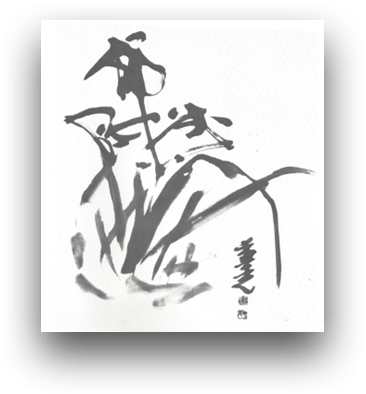
My partner Lew, a scholar of Korean Buddhism, had arranged a book contract with the monk, who recently had become notorious in Korea. A year earlier he was curator of the magnificent collection of Korean Buddhist art at Tong-do Monastery Museum. Then his newspaper article appeared on “Unlimited Action”, describing the form of Korean Seon Buddhism he practiced.
The philosophy of unlimited action itself elicited no controversy. Every generation or so a highly enlightened Buddhist monk appears who can move beyond behavioral restrictions of monastic practice to become a “dirty mop”. A dirty mop befriends the unenlightened and shares their habits to establish rapport, offering non-judgmental compassion. Acting without limits, this enlightened being brings glimmers of understanding and Buddhist calm to those imprisoned by desire and delusion, people who might never encounter a path to greater understanding.
That’s the social utility side of unlimited action. But the monk’s article went on to expand on further implications of this rare type of enlightenment. “Every being has Buddha-nature. When you have sex with another being, their Buddhanature is unloosed. When I have sex with a woman I touch her Buddha-nature. I’ve have sex with hundreds of women. Sex with a goat, touch her Buddha-nature. Sex with a pig, touch her Buddha nature. Nirvana!” he had written, in rhythmically ambiguous prose some construed to mean the monk had sex with goats and pigs.
So if acceptable as philosophy in the abstract, unlimited action can raise issues of social propriety. When the article appeared, powerful politicians and Korean Christian coalitions were offended. In response to the outrage, Jung-kwang was stripped of his curatorship and sent to the simple residence where he generously entertained me this evening.
“Let me explain how we will market your book. Our strategy will flow together with the Ministry of Culture and the chaebols to bring your art and your spirit around the world, creating
understanding of Korean culture and giving you unparalleled exposure in global markets.” Like I said, my Chinese tended toward flowery.
Jung-kwang laughed. “The spirit will flow of its own accord. The art will be what it is. The exposure is nothing. What is the reason to make the book?”
“Well, to bring your art into the world, and help sell your art, and make you some money!”
“But why put such energy, such heart, into this book?”
“Why? To make it a success!”
“Success? What is success?”
“Why, to achieve your desire.”
“Ah, yes.” said the monk, contemplatively.
I remember thinking, as we sipped our whiskeys, My years of classical Chinese are paying off. This monk was a free-spirit and a prolific artist. Intensely curious about this unusual man and what he thought, I drained my glass and turned the conversation back to the monk.
“Tell me, how did you become a monk?”
“My mother was a widow. I was active, in the streets, without control. I loved to draw. I was wrongly accused, but no matter, I lived in delusion and was destined for punishment anyway.”
“What do you mean, destined for punishment?”
“My intent was not good. I suffered from attachments. I loved wine, women, and song. I loved to enjoy the senses. But I had no direction. My life had no meaning. My heart was empty. I
was active, but active without pure intent. While in jail I reflected how to purify myself. When I got out I went to the Tong-do temple and learned to manage the mind. When you manage the
mind, you can act freely, because intent is pure, not selfish.”
“But you drink whiskey and eat meat! And you’re a monk!”
“Ah, Yes. Rules. We think there are rules. We think there is good and there is bad.”
“But isn’t it bad to overindulge the senses?”
“No act is good or bad in and of itself. ‘Good’ and ‘bad’ exist only in our minds. We make up rules. Then we punish ourselves.”
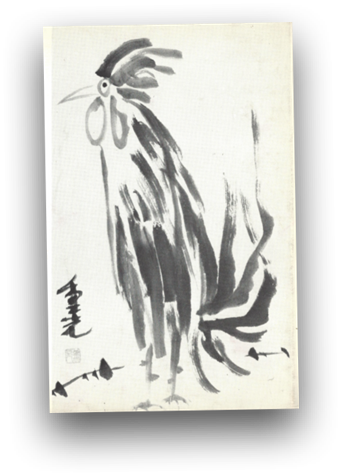
“So, potentially, anything, any act, is OK?”
“If intent is pure, not selfish. If the act is driven by compassion.”
“Even killing someone?”
The monk laughed.
“Padmasambhava.”
“Padmasambhava?”
“Padmasambhava. Buddha’s disciple who brought the teaching to Tibet. He saw politics contradictory to liberation of the spirit. To further the purpose of all sentient beings, he performed a mystical activity killing the son of a wicked minister. His intent was pure.”
“So he killed someone?”
“His intent was pure.”
As we talked, the monk replenished the scotch, this time pouring a bountiful glass for Auntie. After lustily downing the last of her rice and vegetables, she raised her Johnny Walker and smiled happily at me. She followed the conversation with bright-eyed attention, rapt in the backand-forth as if she understood every word.
“What about you?” the monk asked. “You once were a professor of poetry? Have you left it behind?”
ehind?”
“Well, that was years ago. Those days are gone. Being serious about poetry is a luxury I no longer can afford now that I’ve set out on the sea of commerce. But I remember some.”
I thought back to the first Chinese poems I learned, so many years before, when still an undergraduate, a poem by Wang Wei familiar to every Chinese school child. I recited it for the monk.
空⼭不见⼈ Empty mountains, no one to see,
但闻⼈语响 Only echoes of speech are heard.
返景⼊深林 Late rays enter a deep grove
复照青苔上 Again, light on dark green moss!
There was a pause.
“Wang Wei was also a Chan Buddhist like me. From the 8th century,” Jung-kwang finally noted.
“Chan, Seon, Zen, all the same,” I remember saying. My speech was beginning to slur.
“Chinese, Korean, Japanese.”
“Yes, they all mean to meditate… Why do you remember this poem?”
It’s unlikely I was sober enough to describe to the monk the ‘expanded moments’
encountered in so many Tang Dynasty poems. However, I’d like to believe I told him, “I enjoy poems that capture moments shimmering between being and nothingness, impermanence and
eternity, moments slight as a faint breeze, that tie you to the universe.”
“Being present,” said Jung-kwang. “Meditation.”
In the inspiration of an altered state, speaking Chinese with a Buddhist monk, my mind switched to rhythms and images of the Tang poets I had loved. Without thinking, in clumsy
Chinese characters I wrote out a four line Tang-style short-verse poem punning on the monk’s adopted Buddhist name,
DoubleFlash” or Jung-kwang:
光光重光光 Flash flash! double flash flash!
⾃⼼来佛亮 From the heart comes the light of Buddha.
双双再双双 Pair after pair, again pair and pair
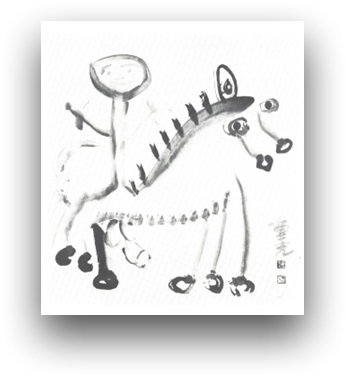
⼈物跨阴阳 Man and beast ride Yin and Yang
The monk laughed uproariously. Immediately he took out a roll of rice paper and a large brush to inscribe the poem in a beautiful
freestyle vertical calligraphy. And alongside he wrote a title: “Written after Drinking Whiskey with Monk Doubleflash.”
